
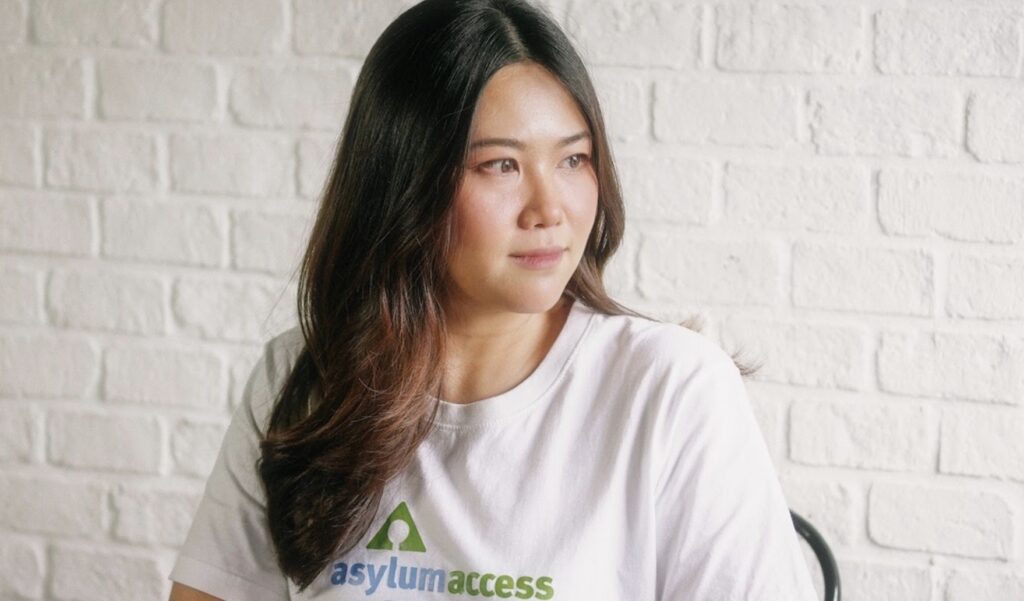
DTP alumna Tanyakorn Thippayapokin, known to friends as Yves, is the Advocacy and Engagement Coordinator for Asylum Access Thailand (AAT). Established in 2007, AAT is a Thai NGO that provides comprehensive support to refugee communities and asylum seekers in Thailand. Yves leads the strategic evidence-based advocacy of the AAT and acts as its official spokesperson. She has a strong moral commitment through to her work, to contribute to changing peoples’ lives.
Thailand hosts diverse refugee and asylum-seeker populations. This includes more than 100,000 refugees from Myanmar living in nine temporary shelters along the Thai-Myanmar border, many of whom have been displaced for decades, as well as more than 5,500 refugees and asylum-seekers living in urban areas across the country. Since the 2021 military coup in Myanmar, renewed conflict and human rights violations have driven further displacement, including among people seeking protection in Thailand, and the introduction of military conscription has further contributed to displacement and concerns about forced recruitment. Alongside the long-established refugee population along the border, Thailand’s urban refugee and asylum-seeker population comprises people from more than 45 countries, reflecting a diverse range of displacement and protection contexts. AAT focuses specifically on urban refugees and asylum-seekers, working to strengthen their access to legal protection, rights, livelihoods, and opportunities to live safely and independently within Thai society.
As Thailand is not a party to the 1951 Refugee Convention or its 1967 Protocol, and has no domestic law on asylum, Thailand treats asylum seekers and refugees arbitrarily. It does not provide any support services or protection. Although Thailand implemented the National Screening Mechanism (NSM) in September 2023, it provides “Protected Person” status rather than refugee status, as “refugee” is not a status recognised under Thai domestic law. Protected Persons receive official documentation, temporary permission to stay in Thailand, protection from refoulement, and access to certain basic services, including education and healthcare. However, the status does not currently provide a right to work, leaving significant barriers to self-reliance. Deportations and refoulement remain ever present risks for those without Protected Person status. In this context Yves work is extremely important in upholding rights and dignities of refugees and asylum seekers in Thailand – and advocating for change.
About DTP training Yves said:
“It was one of the best trainings of my life. The program went beyond the theory and it helped us explore practical advocacy strategies, coalition building, and ways to engage constructively with different stakeholders.”
Yves values the networking and peer learning aspect of the DTP training.
“In our training participants came from different countries who work on a wide range of human rights issues. Despite of our differences and diverse backgrounds, I realised that many of the challenges we face are interconnected”.
Yves has a very particular memory from her DTP training. About a week after the program concluded, one of the Timorese participants took part in a big protest and was arrested and detained. Yves and other DTP participants coordinated among each other through WhatsApp and contacted Amnesty International and Human Rights Watch and other regional CSOs to call for their friend’s release. Their friend was released. For Yves it was a powerful lesson in solidarity and collective action.
Yves’s motivation to defend human rights comes from her experience of growing up in Thailand witnessing inequality from a young age
“It raised so many questions in my mind, I wondered what it truly means to have rights as a human being, and why some people are able to live with dignity, while others face systematic barriers because of where they were born”.
Yves came to know first-hand about the struggle of refugee lives in Thailand Yves when she was volunteering for a refugee community in Thailand during her studies at Thammasat University.
Yves is engaging in the current UPR review of Thailand to highlight the issues of refugees asylum speakers and was initiated the framework and in the editorial team of the policy report The Study on the Economic and Social Impact of Granting Work Rights to Refugees in Thailand: A Case Study of Tak, Chiang Mai and Bangkok” . This report argues for fair inclusion of refugees into Thailand’s economy, and an end to their exploitation.
Yves said she applies knowledge learned from DTP training in her lobbying, advocacy and engagement work, preparing well before dialogues and meetings.
“Everything that I learned, I always use in my work right now.”
Yves attended the 33rd Annual Regional Human Rights & Peoples’ Diplomacy Training Program.