
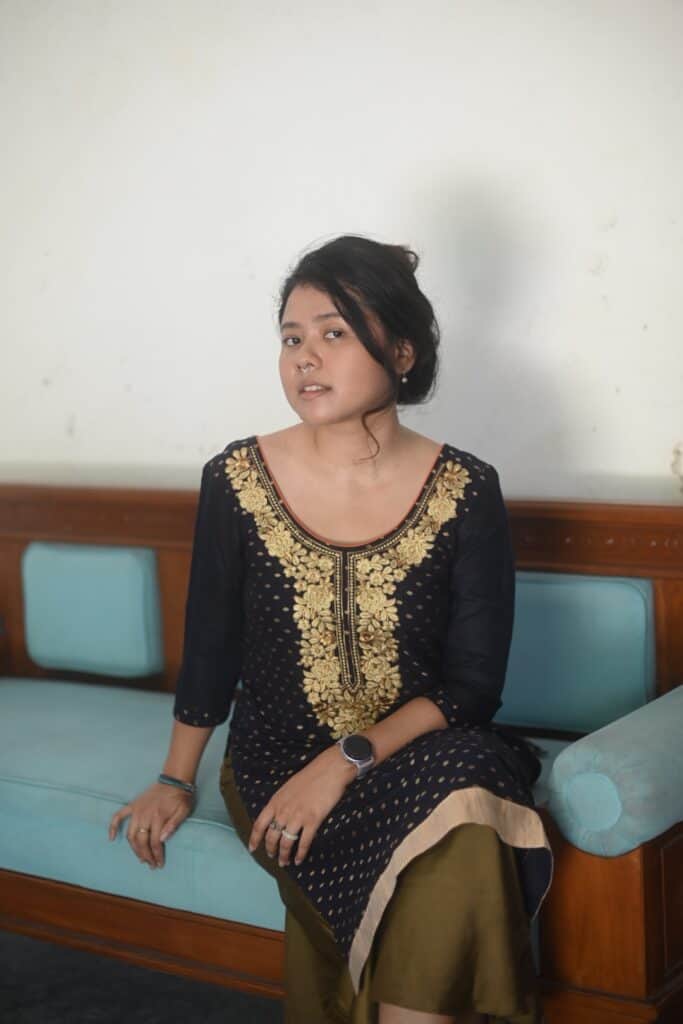
DTP alumna Safina Maulida is an Indonesian researcher, peacebuilder and ecofeminist activist who spends her time between Jakarta, Bangkok and Chiang Mai. She is the co-founder and Director of Resister Berdaya Pulih (RBP) – the Resilience Collective in English. “Resister” is Indonesia’s first ecofeminist collective focusing on building solidarity among grassroots movements resisting the dispossession of communities’ living spaces and livelihoods driven by capitalism, colonialism, and patriarchy, while supporting efforts to build a resilient planet.
Safina is also a performance artist and an author.
Safina said she co-founded “Resister” in 2017 while in college, as she saw that ecological advocacy at the time was “mostly run by men” and centered in major cities.
There was less information on the gendered impacts of the extractive industries, and women’s perspectives and experience are often unheard and overlooked.
“Resister” is now building a unique feminist GIS database called “Local Archives” focused on mining affected areas. The work is currently ongoing in Gede Pangrango, less than 100 km from her hometown, as well as in Trenggalek, Poco Leok, and West Papua is the site of one of the largest copper and gold mines in the world.
Local Archives differs from regular GIS platforms as it captures women’s accounts of what mine affected areas were before and after the mining began. Women’s narratives of what a place was, what crops grew there, how the forests and watersheds were and what they meant to communities before mining and what they become after mining forms the bedrock of this powerful project.
“Most mining GIS systems rely primarily on satellite imagery to map mining sites, providing corporations with geographic data to plan and facilitate resource extraction. We want our project to be different. In our project we want to encapsulate women’s memory of those sites because the land, and obviously in West Papua, was not and is not an empty land. We want our GIS dashboard to show things that we lost because of extractive macho industries through the memories of women, memories of the local communities.”
Even though she joined the DTP training after having over a decade of experience in feminist advocacy, Safina has very high opinion about DTP training,
“DTP is a valid platform for activists in the region of Asia and the Pacific. I gained a lot from DTP including how to use advocacy tools, and how to negotiate between globalism, regionalism and the local.”
Safina said in the regional NGO and civil society sector there is always a subtle push to converge or align local movements with the global. However, she believes this approach is not always effective, as it risks becoming overly focused on international agendas while losing touch with local realities.
“DTP training encouraged us to stand our ground, and to really look at the things that work locally, that is why I emphazise Translocal-solidarity to not lose ourselves in the midst of spiralling of internationalization.”
Safina said that after DTP training, confidence among the participants had grown.
“DTP provided a platform, a safe space where we can meet and collaborate with a lot of people. After the training, I made a collaboration with friends from West Papua. We were together at an international forum and we held an event where we invited advocates and people from 11 countries. We linked together food, feminist indigenous knowledge, culture and human rights in West Papua. It went really well.”
A key motivation for Safina’s activism is rooted in her childhood. She said she experienced and survived, and witnessed gender-based violence in gender unequal environment. Therefore, everything she does now reflects into championing and standing for women rights.
Safina is aware of the risks, including the burnout associated with her activism, and with having to negotiate closing spaces for civil society. There was one time when in West Papua someone followed her for 10 days. This kind of psychosocial hazard adds to the stresses. .
“What gives me courage is acknowledging that I have fear. I mean, people quite often ask me, how can you be so brave? And I say, no, I’m not. I’m not at all. I do it afraid”
Safina attended the 33rd Annual Human Rights and People’s Diplomacy Training Program for Human Rights Defenders in the Asia-Pacific