
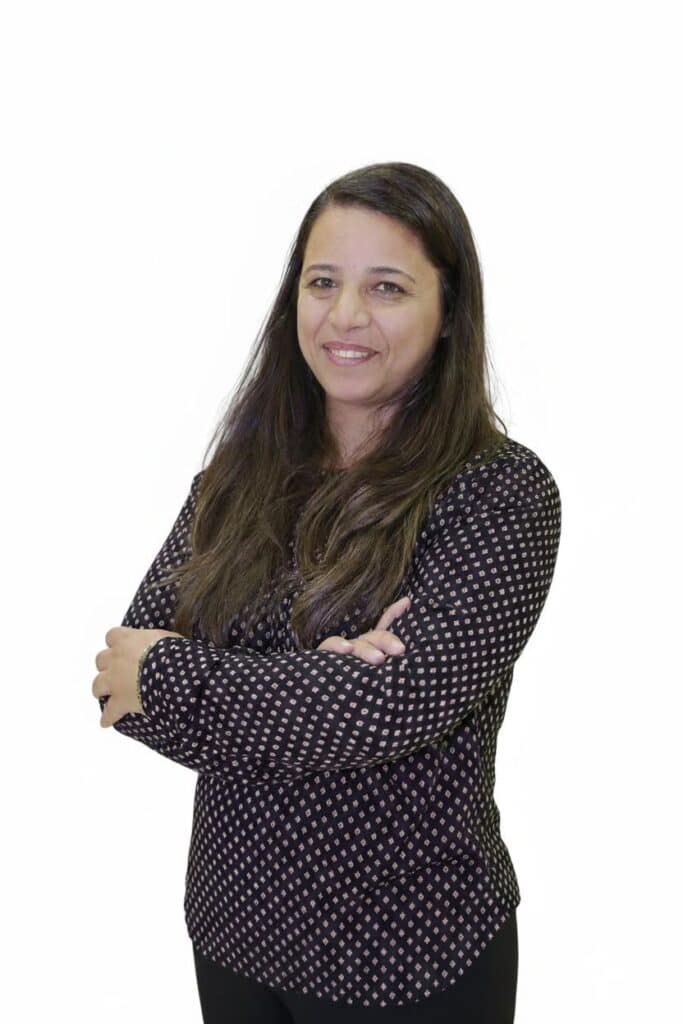
DTP alumna Noha Roukoss is the advocacy manager at Caritas Lebanon, where she leads Caritas’s national advocacy strategy on migration, protection, and humanitarian policy. Noha oversees integrated advocacy campaigns, produces evidence-based policy briefs, and ensures that frontline realities are translated into useful policy demands.
Before becoming Advocacy Manager, Noha managed Caritas Lebanon’s Protection Portfolio. She led programs on migration, detention monitoring, gender-based violence, child protection, and protection from sexual exploitation and abuse. All together Noha has over 25 years of experience working to promote and protect the rights of vulnerable migrants in Lebanon. Women migrant domestic workers have been some of the most hidden victims of war in Lebanon as reported here.
Noha’s career began on the frontlines, working inside administrative detention facilities in Lebanon where undocumented migrants were being held, providing psychosocial support to migrants, monitoring conditions to prevent torture, and coordinating with law enforcement, diplomatic missions, and UN agencies. Noha worked for the release of these women from detention into more dignified and supportive shelters.
In 2014, Noha participated in Migrant Forum in Asia (MFA)/DTP’s 3rd Annual Regional Capacity Building Program on Human Rights Advocacy and Migrant Workers in the Middle East and North Africa. Although she already had years of field experience, said that what DTP offered was something different:
“DTP helped me understand that frontline work and advocacy are not separate. For years, I supported migrants in detention and shelters, focusing on their immediate protection needs. Through DTP, I became more intentional about documenting their experiences, recognizing recurring patterns of rights violations, and using that evidence to advocate for meaningful policy reform.”
That shift—from service delivery to structured advocacy—became central to Noha’s work.
“Through DTP, I strengthened my understanding of international human rights mechanisms and learned how to frame local protection challenges within global standards. DTP connected the local and the global for me. It helped me see safe migration not just as service delivery, but as a human rights obligation of states.”
In 2016, Noha returned to DTP as a key trainer in Bangladesh for the MFA/DTP program on civil society advocacy for migrant workers and safe migration, linking her work in Lebanon with where the journey of many migrants, and their vulnerability to abuse, begins.
“Being invited back as a trainer was powerful. It showed me that DTP is not just a training—it is a community of practice. We learn from one another, across countries and contexts.”
DTP’s Executive Director, Parick Earle, commented that Noha was an excellent trainer who was able to relate her work in Lebanon very practically to the work of advocates in Bangladesh – and to build valuable collaborations for more work along the migration route.
Beyond Lebanon, Noha delivered safe migration training in Bangladesh, Nepal, Ethiopia, and the Philippines. She also served as Secretary General of the Social Workers’ Syndicate in Lebanon (2016–2023), leading national advocacy and legislative engagement. Her publications and training manuals on trafficking and gender-based violence were supported by the European Union, U.S. Embassy, and British Embassy.
For Noha, advocacy is not abstract. It is built on years of listening to detainees, migrant domestic workers, and refugees whose rights were violated or ignored. Noha said that DTP helped her articulate that experience within a broader political and institutional framework.
“DTP reinforced my belief that advocacy is a long-term commitment. Change does not happen overnight, but when you build alliances across regions, you amplify the voices of the most vulnerable.”