
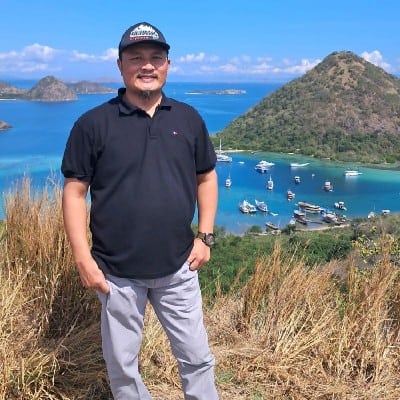
Mimin Dwi Hartono is a senior policy analyst at Indonesia’s National Human Rights Commission – KomnasHAM. It is nearly 20 years since he participated in DTP’s flagship annual training in 2007, but the memories of the training and its value are still strong.
KomnasHAM played a critical role in Indonesia’s transition from the authoritarian rule of the Suharto to the democracy and “transformasi” of the 2000s. As Asia is a region without a regional human rights mechanism, national human rights institutions such as KomnasHAM have an even more important “watchdog” role, holding the state accountable. This role has come to the fore with growing concerns about the current Indonesian government’s actions to amend human rights laws and reduce the power and independence of KomnasHAM.
Mimin has worked for KomnasHAM for over 20 years across four core areas of the organization including research and study, education and public outreach, investigation and monitoring, and mediation. His work combines both research and advocacy, investigating critical human rights issues and disseminating findings and making recommendations to the Indonesian government.
Mimin choose to be human rights defender because when he was growing up in Yogyakarta. Near Mount Merapi, he saw how illegal logging and mining threatens the environment and peoples’ lives. He became involved in community organisations and advocacy to push back against mining and illegal logging. Mimin was very active in community and advocacy organisations such as Walhi (Indonesia Environmental Forum), Wana Mandhira Foundation (Community based environmental organization) and SEACA (South-East Asia Committee for Advocacy). These experiences shaped his passion for human rights.
Mimin joined DTP’s 17th Annual Regional Human Rights and Peoples’ Diplomacy Program held in Wellington, New Zealand in 2007, a three-week intensive program with participants from across Asia and the Pacific.
“I was in my second year at KomnasHAM. At that early stage of my career, I found DTP training was very useful to deepen my knowledge on UN human rights mechanisms. I formed a good understanding about how these mechanisms work – and their limitations.”
Mimin said that he applied the knowledge gained from DTP training to his work at KomnasHAM, to identify which cases were eligible for international human rights mechanisms.
“Back then not many staff were working at KomnasHAM. I was handling over 100 cases per month, which means 5-6 cases per day. DTP training enabled me to identify eligible cases for international human rights mechanisms.”
but he Mimin said DTP training also provided a space for him to connect and meet with human rights defenders from many countries including Indonesia. He developed long lasting professional friendships with other Indonesian participants including prominent lawyers and human rights advocates in Indonesia.
“I don’t see my job at KomnasHAM simply as a job, I believe in its mission of strengthening human rights protection, enforcement, and promotion.”
Mimin also raises awareness about human rights in Indonesia through teaching international human rights law at university, delivering training to police, prosecutors, and civil society members on human rights related issues and as a public speaker on freedom of expression, drug policy and human trafficking, child rights, and Indigenous Peoples’ Rights.
Mimin is one of hundreds of Indonesian DTP alumni spanning three decades of commitment to defend human rights and to build a society that respects the dignity of all, the vision of its independence leaders and founders.
Mimin Dwi Hartono attended DTP’s 17th Annual Regional Human Rights and People’s Diplomacy Training Program in 2007, held in New Zealand