
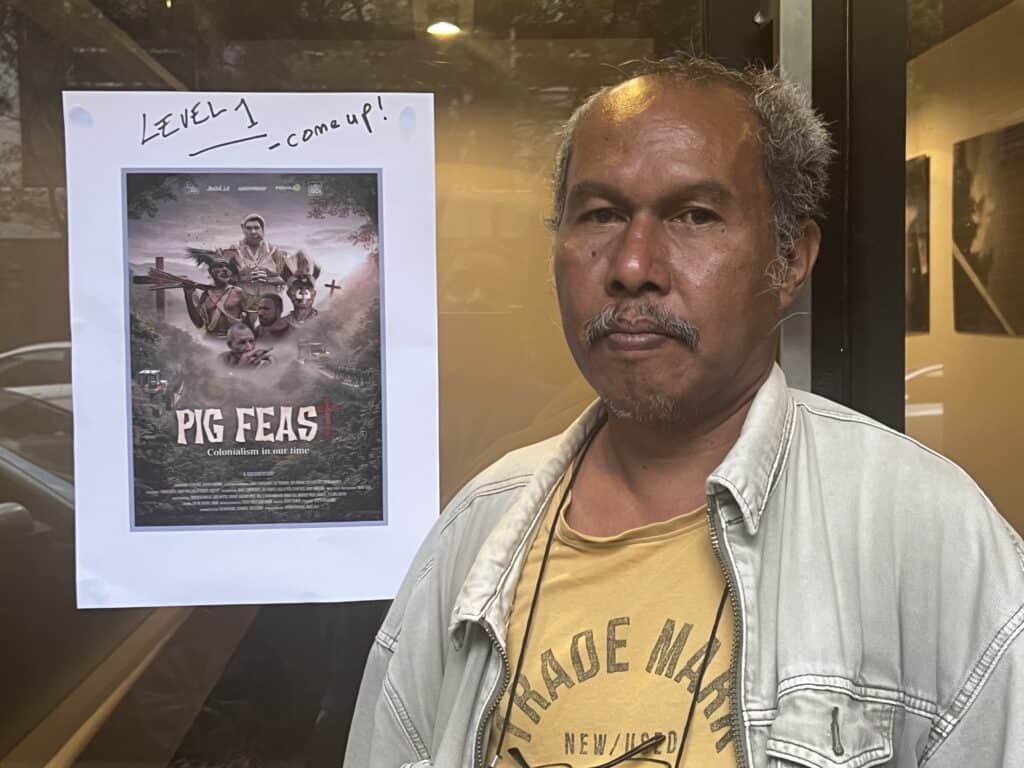
DTP alumni Victor Mambor is a journalist and film maker in Jayapura, West Papua, Indonesia. He is the co-founder and an editor at Jubi (Tabloid Jubi), a leading independent media outlet based in Jayapura, West Papua, Indonesia.
The extent of human rights violations and abuses in West Papua has been difficult to verify independently as the Indonesia government has denied entry to the UN’s human rights monitoring mechanisms, despite many appeals. Independent journalists have also been denied access. Reports by Amnesty International, Human Rights Watch and others have highlighted increasing abuses and violations in the context of growing armed conflict and militarization.in West Papua.
Witnessing these violations as he grew up was a turning point for Victor. As an Indonesian, the experience was both personal and political. “I felt angry,” Victor says. “We are all Indonesian, but there is discrimination. People in Papua are treated unequally.”
This sense of injustice pushed him toward advocacy journalism and film making, where documenting lived realities of West Papuans became a form of resistance for him.
Victor came to Sydney recently to showcase a film called “Pesta Babi” or Pig Feast in English. Amnesty International hosted the screening at its Sydney office.
Pig Feast highlights the massive scale of land clearing in West Papua for agribusiness projects, including sugarcane plantations for bioethanol. The documentary features Indigenous Papuan voices opposing these developments, emphasising their desire to preserve their natural environment, clean rivers, and traditional cultures and food sources.
“The film is about how Indigenous people struggle for their rights when their forests are taken,” Victor explains. “The government comes to their land and cuts the trees. This is a violation of their rights.”
Victor first learned about the Diplomacy Training Program (DTP) through colleagues while working with a Papuan NGO network. Encouraged to apply, he later joined a DTP training program in Chiang Mai focused on Indigenous peoples, business, and human rights.
“The training was very good, it helped us understand how to use mechanisms to work for Indigenous peoples, especially in relation to business and land.”
One of the most significant outcomes of DTP training for Victor was the opportunity to connect with fellow human rights defenders from across the region.
“I made many friends—from Fiji, Nepal, Thailand, Pakistan we still share information about our situations. It’s an exchange of knowledge. DTP training was not just about learning frameworks—it was about building a regional community of human rights defenders.”
In a region marked by complex political challenges, these networks remain essential.
He points to ongoing tensions, militarisation, and the lack of accountability as major challenges affecting Indigenous communities in West Papua. “I don’t think there is much awareness about human rights by the Indonesian military who are in West Papua.”
In the Q &A after the session, Victor said that his house was bombed twice because of his work. Despite these risks, Victor continues to document and report on these issues, using journalism and film making as tools for visibility and advocacy.
For Victor his mission remains clear: to ensure that the voices and struggles of West Papua’s Indigenous communities are seen, heard, and remembered.