
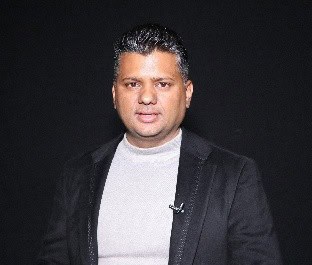
DTP alumni Prakash Khadka is a dedicated human rights advocate and development practitioner in Nepal who for over 15 years has been working over issues such as child rights, migration and social justice. He is the Founder of Peace Himalaya, a not for profit organization in Nepal which is committed to foster peace, justice, and human dignity in society.
Prakash’s journey into human rights advocacy began long before his professional career. As a student activist, he was involved in international Catholic social movements, particularly Pax Romana, where he first encountered ideas about justice, dignity, and global solidarity.
In later years, Prakash held several leadership roles in multiple reputed organizations including Executive Director of Jagriti Child and Youth Concern Nepal, National Director for Justice Ventures International (USA) in Nepal, and senior program positions with Caritas Nepal and Felm Finland. He also served as the Communications Desk Coordinator during Nepal’s 2015 earthquake response.
A turning point in Prakash’s advocacy journey came when he joined the DTP training. A year earlier, he had attended a session of the UN Human Rights Council, but the experience left him with more questions than answers.
“I had been in the UN Human Rights Council the year before the DTP training, but without prior knowledge of the UN system, it was very difficult for me to understand what was happening in that big hall.”
Prakash said that the DTP training helped bridge that gap. Through intensive sessions on international human rights mechanisms, advocacy strategies, and engagement with the UN system, he developed a clearer understanding of how civil society can influence policy making.
The knowledge Prakash gained through DTP soon translated into concrete action. Drawing on his understanding of UN mechanisms, he began engaging more actively with international human rights processes, including contributing to Nepal’s Universal Periodic Review (UPR). He was a changemaker in that perspective. “There was a knowledge gap in Nepalese civil society about UPR process, I took the initiative to encourage them to contribute in UPR.”
In one recent example, Prakash helped a small group of refugees living in Kathmandu who had little opportunity to make their voices heard. Nepal is not a signatory to the Refugee Convention and officially does not recognize refugees, which makes advocacy on their behalf politically sensitive.
Despite these challenges, Prakash facilitated meetings between the refugees and a visiting UN Special Rapporteur, ensuring that their concerns were documented and included in the Rapporteur’s reporting process.
For Prakash, moments like these demonstrate the lasting value of the training. “I’m still using what I learned. Unlike many other training programs where participants disappear afterwards, this training has remained practical and relevant in my work.”
Reflecting on Nepal’s current political moment where Gen Z toppled the previous Nepalese government and an election was recently held, Khadka sees both opportunity and uncertainty for the future of human rights and justice in Nepal.
While elections have opened space for political change, Prakash believes that Nepal still faces deep structural challenges, including corruption, and the need for stronger democratic institutions. For him, the task ahead is not only about electoral outcomes but about ensuring that democratic processes translate into meaningful improvements in people’s lives.