
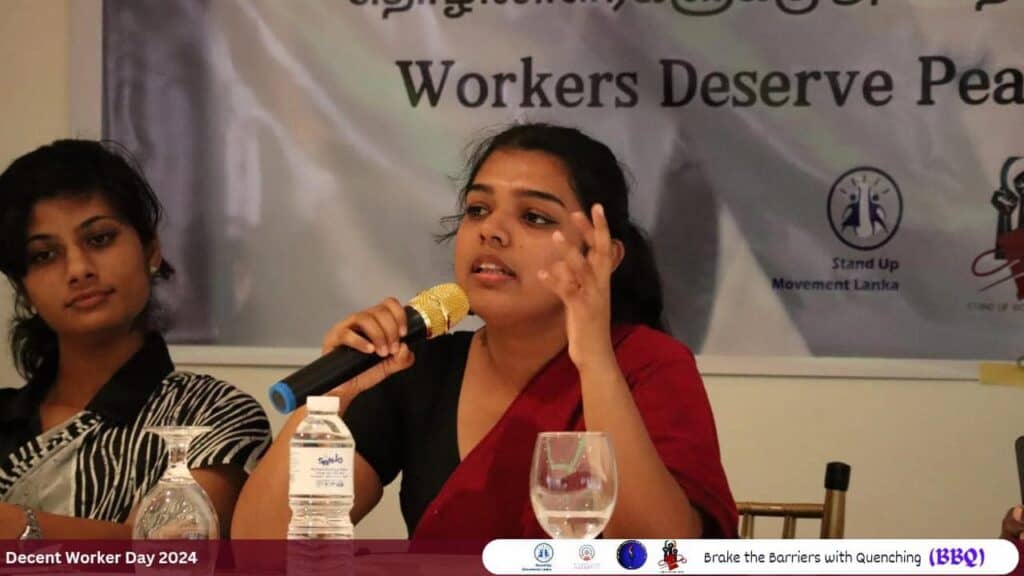
DTP alumna Tharushi Fernando is a human rights advocate and an attorney at law at the Supreme Court of Sri Lanka where she focuses her work on public law, minority rights, labour rights, and accountability for human rights violations, including cases related to police custodial killings, torture, and labour rights violations.
Presently, Tharushi is pursuing a master’s degree in human Rights and Democratization at Mahidol University, Thailand under the Asia-Pacific scholarship programme.
Her professional experience reflects a strong commitment to marginalized communities. Previously she has worked with the Human Rights Commission of Sri Lanka, the Law and Society Trust, the Textile and Garment Workers’ Union, and the Centre for Society and Religion.
Reflecting on her experience with the Diplomacy Training Program (DTP), Tharushi describes it as transformative.
“DTP was my first international training programme, DTP introduced me to a more strategic and systematic approach to advocacy. Prior to the training, much of my activism was grounded in direct action and protest movements. DTP expanded my perspective, helping me understand how diplomacy, international collaboration, and carefully designed advocacy strategies can strengthen human rights work.
“The training changed how I think about advocacy,” she reflects. “It helped me move from reactive action to strategic engagement.”
Beyond the classroom, DTP also expanded her professional network in meaningful ways.
“DTP training was very practical in connecting participants and creating lasting relationships. For example, when I recently came to Nepal, I was able to find support for accommodation through the DTP network. I have also collaborated with DTP’s network on advocacy work related to legal cases in Sri Lanka recently. This network is different from other international networks I know. It is proactive, responsive, and always willing to help.”
Born and raised in Colombo, Sri Lanka, in a Catholic family, Tharushi’s early understanding of human rights and justice was profoundly influenced by the values instilled by her teachers, sisters, and priests. Rather than a purely doctrinal education, she was introduced at a young age to ideas rooted in liberation theology — justice, inequality, neo-colonialism, and the harsh realities faced by marginalized communities.
A defining turning point came when she was just 17 and travelled to Jaffna, a key site carrying painful memories of Sri Lankan civil war.
In Jaffna Tharushi witnessed the enduring scars of war on Tamil communities — families torn apart, communities living with grief, and the lingering absence of justice. One encounter stayed with her forever. She met a young girl who had lost her parents in the conflict, and she said to Tharushi that she wanted to become a lawyer so she could seek justice for the killing of her parents. That moment deeply moved Tharushi and solidified her own decision to study law.
Looking ahead, Tharushi remains deeply concerned about the challenges facing human rights in Sri Lanka, particularly the lack of accountability for past abuses, persistent ethnic tensions, and the need for stronger alignment with international human rights standards. Yet, Tharushi is hopeful because in her opinion, “it takes time to make meaningful change, but change is very much possible”.