
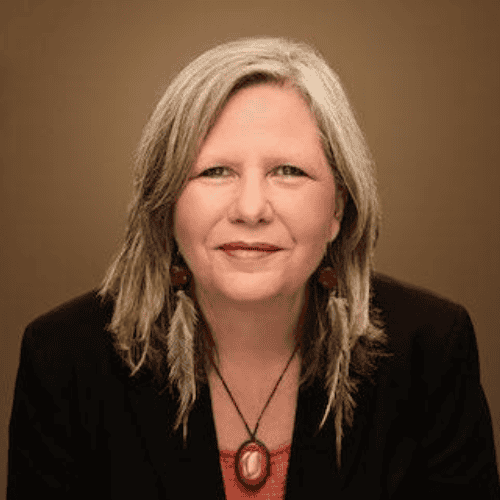
DTP alumna Cathryn Eatock is a Gayiri and Badtjula woman who has dedicated 35 years of her life to promoting and defending Indigenous Peoples’ rights in Australia and the Pacific.
Currently Cathy is the Chief Executive Officer (CEO) of the Indigenous Peoples’ Organization – Australia (IPOA). IPOA is a network of 370 Australian Indigenous Peoples’ organisations and individuals committed to advocating for Indigenous Peoples’ rights and the implementation of the Declaration on the Rights of Indigenous Peoples within Australia.
Cathy was also the elected Pacific Co-Chair of the Facilitative Working Group (FWG) of the Local Communities and Indigenous Peoples Platform (LCIPP) under the United Nations Framework Convention on Climate Change (UNFCCC). She was a member of the Australian Department of Foreign Affairs and Trade (DFAT) Indigenous Committee from 2021-2023.
Cathy first participated in DTP’s program in its inaugural program round in 1990, when it was led by its co-founder President José Ramos-Horta. However, she fell ill and could not complete the program, but she returned many years later to participate in its 14th Annual Human Rights and Peoples’ Diplomacy Training Program – where José Ramos-Horta was a trainer again.
Cathy holds a high opinion of DTP training:
“Even after years of advocacy and activism, I found the DTP training to be helpful and enriching. It offered a fresh perspective on human rights work and equipped me with practical tools that I continue to use. One of the most valuable aspects was the opportunity to build connections with a diverse group of advocates from around the world. The training was of exceptionally high quality—well-structured, engaging, and led by experienced facilitators. It strengthened my capacity to contribute more effectively to international advocacy efforts.”
Cathy’s activism began as a young woman in 1987 in the influential Committee to Defend Black Rights – campaigning for the landmark Royal Commission into Aboriginal Deaths in Custody. This brought to national attention the number of First Nations people arrested, and subsequently dying in custody, with no accountability by the state. It was the raising of the issue at the United Nations that contributed to the announcement of the Royal Commission.
“It was then I realised the value of using the UN to leverage the recognition of the rights of First Nations peoples,” she said, recalling how international attention helped the domestic push for justice. “Australia was exposed before the world and recognised they needed to act.”
In 2011, Cathy first attended the UN Permanent Forum on Indigenous Issues in New York and has since led Australian Indigenous delegations and presented to multiple UN bodies, including the Human Rights Council and Expert Mechanism on the Rights of Indigenous Peoples and the COP climate change conferences.
Cathy sees the value of using international standards and mechanisms, and in participating in international forums so that Australian governments can be held to account, and state violations of Aboriginal and Torres Strait Islander human rights in Australia can be challenged.
“The issues of deaths in custody we were raising 30 years ago are still prevalent. More First Nations women are being imprisoned than ever. We are seeing even more of our young people incarcerated so that we are now the most incarcerated population in the world.”
The issues of injustice, racism and abuse of First Nations communities and individuals feature strongly in the most recent NGO submission to the Universal Periodic Review (UPR), where Cathy coordinated Indigenous input in 2025.