
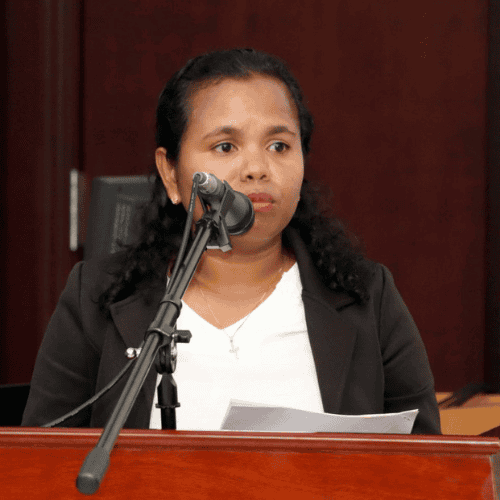
DTP alumna Pascoela Barreto is a coordinator of the Alola Foundation in Timor-Leste. Alola Foundation was founded by Kirsty Sword Gusmão, former First Lady of Timor-Leste with an aim to empower women with the motto Feto Forte, Nasaun Forte (Strong Women, Strong Nation). The Foundation works to improve the wellbeing, opportunities, and leadership of women and children through health initiatives, education support, livelihood development, and gender equality advocacy.
Pascoela leads Alola’s HALIKU Women’s Cancer Program, a role she has held since the program’s inception in 2014. She helped negotiate the foundational MoU with the Ministry of Health, enabling Alola to run the country’s only public awareness initiative on women’s cancers — a work that now spans urban neighborhoods and remote villages alike.
Under Pascoela’s leadership, HALIKU has focused on students, faith groups, civil servants, and volunteers in nationwide cancer awareness—reaching over 20,000 people, training hundreds of health workers, and supporting at least 250 women to access diagnosis and care at Dili National Hospital, including arranging their transport, accommodation, and treatment support.
Pascoela participated in DTP’s 30th Annual Regional Human Rights and Peoples’ Diplomacy training program. She said participation in DTP training was transformative for her.
“The DTP training helped me reframe health access as a human rights obligation and strengthened my practical skills to act on that understanding. I learned how to map power and design advocacy that reaches parliamentarians and bureaucrats. It also equipped me to lobby the Ministry of Health to address systemic gaps in cancer treatment—like the absence of chemotherapy, radiotherapy, and early-detection services, and the shortage of trained specialists and essential medicines in Timor-Leste.”
Pascoela said the training also expanded her professional network—connecting her with peers who share ideas and funding opportunities. “We still keep in touch… sometimes we talk about writing funding proposal together,” she said, noting that these connections have opened new pathways to bring women’s cancer issues onto national agendas.
Pascoela’s upbringing and life experiences are her motivation to advocate for human rights and supporting women. The eldest of nine children in a family with little money, her family could not support her to go to university. What she lacked in money, Pascoela made up for in initiative and determination. With a school friend she wrote a letter to the then First Lady of Timor-Leste, Kirsty Sword Gusmão seeking a path forward; that plea led to a scholarship at the Dili Institute of Technology, where she completed a Bachelor of Computer Science.
When Kirsty Sword Gusmão wanted to establish a women’s cancer project in Timor-Leste in 2014, she requested Pascoela—then still at university—to help build it from the ground up. Pascoela and the Foundation’s project and work on women’s cancer has gone from strength to strength. In 2019 Pasceola won an English scholarship to Australia, building her networks of support and impressing all she met with her drive and commitment.
In September 2025, Alola Foundation opened a dedicated women’s cancer center, providing free accommodation for the most vulnerable, and prioritising those diagnosed with breast or cervical cancer without relatives in Dili.
Pascoela’s vision for the future is a Timor-Leste where cancer is detected earlier, treatment services are stronger, and mortality rates are significantly reduced. She is helping to make that vision a reality.