
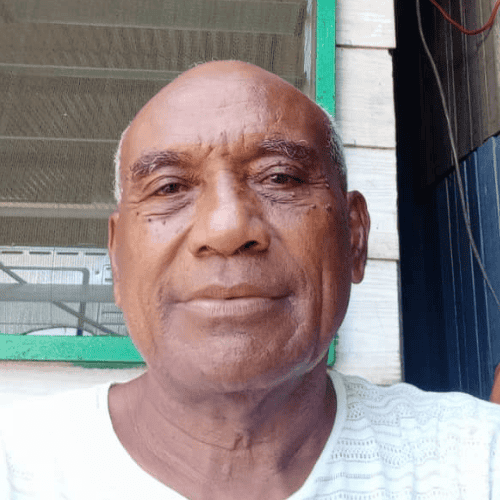
DTP alumnus Patrick Niebo is a senior human rights advocate in Papua New Guinea (PNG) with more than a decade of service at PNG’s Ombudsman Commission, where he led the Anti-Discrimination and Human Rights Investigations Unit from 2005 until 2019.
His work there involved addressing corruption, administrative failings, and human rights abuses ranging from unlawful detention to sorcery-related killings. His expertise spans investigations, treaty reporting, advocacy, and designing trainings that bring human rights principles into practical settings. Patrick now serves as a Director of the Kedu Safe House in Milne Bay Province, which provides shelter and advocacy for survivors of violence.
His notable past experiences include representing PNG at the United Nations Human Rights Council during Universal Periodic Review processes, as well as attachments to the Australian Commonwealth Ombudsman and the New Zealand Ombudsman. In PNG he conducted human rights education and awareness programs across the country, working with police, prison officials, NGOs, communities, faith-based groups, journalists, lawyers and local leaders.
Patrick attended DTP’s signature annual human rights training program in Timor-Leste in 2012. He said the training gave him a renewed sense of empowerment, strengthened his negotiation skills, and helped him realise that he is part of a broader human rights community.
“The training in Timor-Leste gave me confidence in negotiation—how to approach officials, embassies, or institutions to advocate for the rights of people. Before the DTP training, I sometimes held back out of respect for others, but DTP helped me to be more focused and objective in what I needed to do. I also learned a lot from the other participants, how they dealt with challenges in their own countries. Each place had different human rights priorities, and hearing those experiences made the training practical and real.”
Patrick said that for him DTP became a core source of knowledge in human rights advocacy, especially as there were limited opportunities for such training in PNG in 2012.
“When I saw the opportunity about participating DTP training, I thought—wow, this is where I can really learn, and it’s relevant to our region, to our Pacific realities. I was right. DTP training showed me that I am not alone.”
Patrick explained that his motivation in human rights comes from a simple conviction: every person deserves to live with liberty, dignity, and equality. His outlook is shaped by a deep passion for supporting people rather than limiting them. Guided by his Christian faith, he believes that all individuals are created equal, and he consistently challenges cultural or institutional practices that deny people their rights.
Looking back on his career, Patrick recalls cases that left a lasting impact. One involved a prisoner who had completed his sentence but remained unlawfully detained for years because of a missing document. In another, he intervened to ensure that a child living in prison with their mother received proper nutrition instead of being limited to prison rations. Experiences like these reinforced his belief that only through awareness, education, and persistent advocacy can abuses be prevented and vulnerable groups—especially women and children—be protected.